Support natural body detoxification through clean eating, hydration benefits, and liver support. Learn simple ways to enhance toxin elimination and promote lasting everyday wellness.
Boost immune vitality year-round through balanced nutrition, vitamin boosts, gut health link awareness, stress management, and lifestyle habits that promote lasting wellness and disease prevention.
Boost healthy aging through yoga benefits that improve flexibility, balance, and stress relief. Learn beginner poses anyone can master for long-term vitality and wellness.
Learn science-backed breathing exercises that ease anxiety disorders, promote mindfulness, and support stress reduction with simple, effective mental health tools for everyday calm and balance.
Discover how social media effects contribute to rising teen anxiety, supported by mental health studies, coping strategies, and parental tips for protecting adolescent well-being online.
Explore how wearable health technology in smartwatches tracks vital signs, spots early warning patterns, and supports smarter, more proactive health decisions in everyday life.
Explore how CRISPR gene editing is transforming genetic disease treatment, uncovering breakthroughs, safety advances, and the future possibilities of curing inherited disorders through DNA repair.
Artificial skin technology and electronic skin research enable prosthetics, robotics, and burn grafts to sense touch, temperature, and textures like real skin.
Discover how smart thermostats and health are connected by optimizing bedroom temperature to improve sleep quality, support easier breathing, and create a more comfortable, restorative sleep environment.
Explore amazing body facts and discover how the heart, blood, and lungs work together every day to sustain life through blood circulation and lung function.
Discover how genetics, heredity, and family history influence health risks and inherited conditions, helping doctors predict, prevent, and personalize medical care for better well-being.
Learn the most common reasons to see a doctor, from cough and back pain to hypertension and anxiety, and understand when medical attention is necessary.
It’s reported that up to 70% of the population have sensitive skin. More alarming, allergies and skin sensitivities are known to affect millions of patients taking prescriptions every year.
Labs Make New, Dangerous Synthetic Cannabinoid Drugs Faster Than We Can Ban Them
By
Samuel Banister, Iain S McGregor, and Roy Gerona
Synthetic cannabinoids — drugs that mimic the psychoactive effect of cannabis — have been linked to injuries and deaths. When one is banned, another rises to take its place.Sebastien Malo/Reuters
XLR-11, PB-22, AB-FUBINACA, MAB-CHMINACA, 5F-AMB. These are the cryptic and sometimes unpronounceable names of the most dangerous drugs you’ve never heard of. They are responsible for kidney injury, psychosis, seizures, coma and death.
For instance, AB-FUBINACA was responsible for a spate of recent poisonings at Wesleyan University. And MAB-CHMINACA was associated with more than 100 hospitalizations in Baton Rouge. Neither of these drugs were known to the scientific community until late last year.
These drugs are synthetic cannabinoids — several of the hundreds that have been identified as new “designer drugs” in the past five years. More than 150 were reported in 2013 alone, according to the United Nations Office on Drugs and Crime (UNODC). And police, doctors, scientists and lawmakers are all struggling to identify these new drugs as they hit the streets.
What are synthetic cannabinoids?
Synthetic cannabinoids are molecules designed to mimic the effects of tetrahydrocannabinol, or THC. Like THC, these synthetic cannabinoids target the cannabinoid type 1 receptor (CB1R) in the brain, which is responsible for the psychoactive effects of THC in cannabis.
Although these products are sometimes called “synthetic cannabis” or “fake pot,” both terms are wrong and misleading. They are called cannabinoids not because they are like cannabis, but because they interact with cannabinoid receptors in the brain and elsewhere in the body.
These molecules look chemically different from those found in cannabis, and have very different effects in laboratory tests, and on their users, than actual cannabis does.
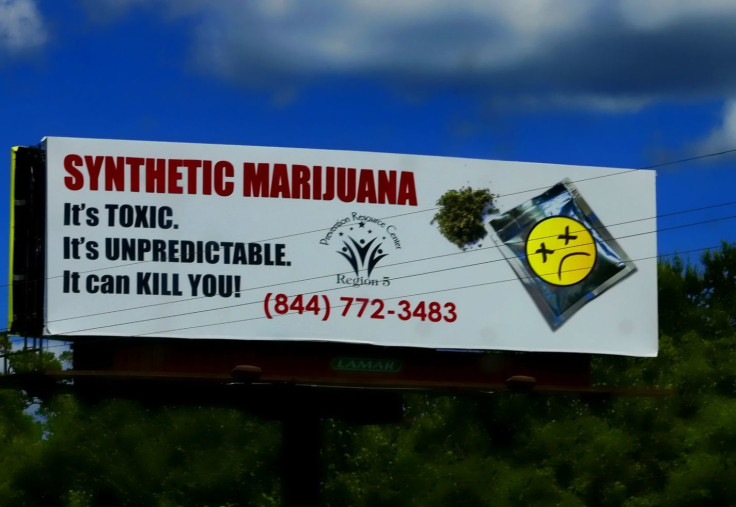
These synthetic drugs are manufactured in clandestine labs (mostly in China) for export around the globe. They are usually sprayed onto dry herbs for smoking, and sold inexpensively in foil packets with constantly changing brand names like Spice, K2, Black Mamba, Cloud Nine, Maui Wowie, Mr Nice Guy and countless others. There are literally hundreds of individual products that are known to law enforcement. The brands change as frequently as the drugs themselves.
Underground chemists tweak the structures of these molecules using tricks similar to those employed in the pharmaceutical industry. Unlike Big Pharma, where the goal is to create safer medicines, synthetic cannabinoid designers want to ensure their products evade prohibition but still get their customers “high.” As molecules are identified and banned, drug labs reformulate their products to stay a step ahead. Consumers can never be sure of exactly what drug (or combination of drugs) they are using.
Dangerous highs. raymondclarkeimages/Flickr, CC BY-NC
Synthetic cannabinoids are getting stronger and more dangerous
As part of a group of researchers from Australia, New Zealand and the United States, we studied the ability of several synthetic cannabinoids that were commonly available in the past few years to elicit a response from CB1R — the cannabinoid receptor in the brain.
The synthetic cannabinoids we tested that were commonly available during 2011-2013 were several times as potent as THC. But the latest drugs from 2014-2015 were up to 700 times more potent. In these tests most synthetic cannabinoids fully activated CB1R. THC, on the other hand, does not fully activate the receptor. This difference may account for the greater toxicity of these synthetic cannabinoids.
Serious illnesses due to cannabis are exceedingly rare, while those due to synthetic cannabinoid use are becoming more common. A recent report by the Centers for Disease Control and Prevention stated that there were 3,572 calls to poison centers in the United States in the first half of this year due to synthetic cannabinoids, a 229 percent increase from the same period in 2014. More concerning is the fact that clusters of synthetic cannabinoid overdose are associated with the newest drugs.
Thousands of people wound up in emergency rooms as a result of outbreaks in Alabama, Mississippi, and New York in April and May alone. Some of these cases were linked to MAB-CHMINACA, but others are likely due to synthetic cannabinoids so new they have not been identified.
Deaths due to synthetic cannabinoids have been climbing steadily as new variants emerge. During the Mississippi outbreak in April alone there were nine deaths associated with synthetic cannabinoid use.
Synthetic cannabinoids have been linked to poisonings and death.Szapucki/Flickr, CC BY NC
The DEA can’t keep up with synthetic cannabinoids
In 2012, President Obama signed into law the Synthetic Drug Abuse Prevention Act (SDAPA), which amended the Controlled Substances Act (CSA) of 1970 to place “cannabimimetic agents” — substances that mimic the effects of cannabis — into Schedule I, the most restrictive regulatory category. Schedule I covers drugs like heroin, LSD and actual cannabis. SDAPA designated several specific synthetic cannabinoids, as well as five chemical classes of cannabinoid molecules, as Schedule I substances. But none of the newest synthetic cannabinoids are explicitly covered by SDAPA.
As chemists modify structures to avoid prohibition, the Drug Enforcement Administration (DEA) adds more synthetic cannabinoids to Schedule I. Since January 2013, the DEA has exercised emergency scheduling powers five times to place a total of 25 synthetic cannabinoids into Schedule I. Keep in mind that more than 150 new synthetic cannabinoids were reported by UNODC in 2013.
Once a specific synthetic cannabinoid is placed into Schedule I, related molecules may be considered illegal due to a 1986 amendment to the CSA called the Controlled Substance Analogue Enforcement Act (also called the Federal Analogue Act). The act allows any substance which is “substantially similar” to a Schedule I chemical to be treated as such. But in each instance that similarity needs to be demonstrated in a court of law — which can be a slow process. In effect, that means chemists can modify molecular structures faster than the government can demonstrate that they are illegal or add them to Schedule I.
For instance, a notice of intent to move MAB-CHMINACA, the drug tied to hospitalizations in Baton Rouge and elsewhere, to Schedule I was filed last month. MAB-CHMINACA, a derivative of AB-FUBINACA, only appeared after AB-FUBINACA was placed in Schedule I last year — and that is probably no coincidence.
Using a proactive approach to combat synthetic cannabinoids
Perhaps it is time we stopped reactively banning new synthetic cannabinoids and considered more innovative regulatory approaches.
In the pharmaceutical industry, the patents for a drug typically include related “prophetic” structures, preventing competitors from making modified versions of the drug. Prophetic structures are molecules that have not actually been created yet, but could feasibly be prepared, and are predicted to have similar effects to the protected drug.
A law passed in Texas on September 1 used a similar approach to prohibit more than 1,000 potential synthetic cannabinoids that are anticipated to appear in future based on trends observed now. This is a creative approach, but 1,000 is still a finite number. And the total number of chemically possible synthetic cannabinoids is larger still.
Proactive prohibition may slow the release of new synthetic cannabinoids. Or it could simply catalyze the release of increasingly elaborate and chemically diverse variants. If the past few years are anything to go by, 2016 will bring a new wave of unknown and untested synthetic cannabinoids, and more challenges for police, doctors, scientists and lawmakers.